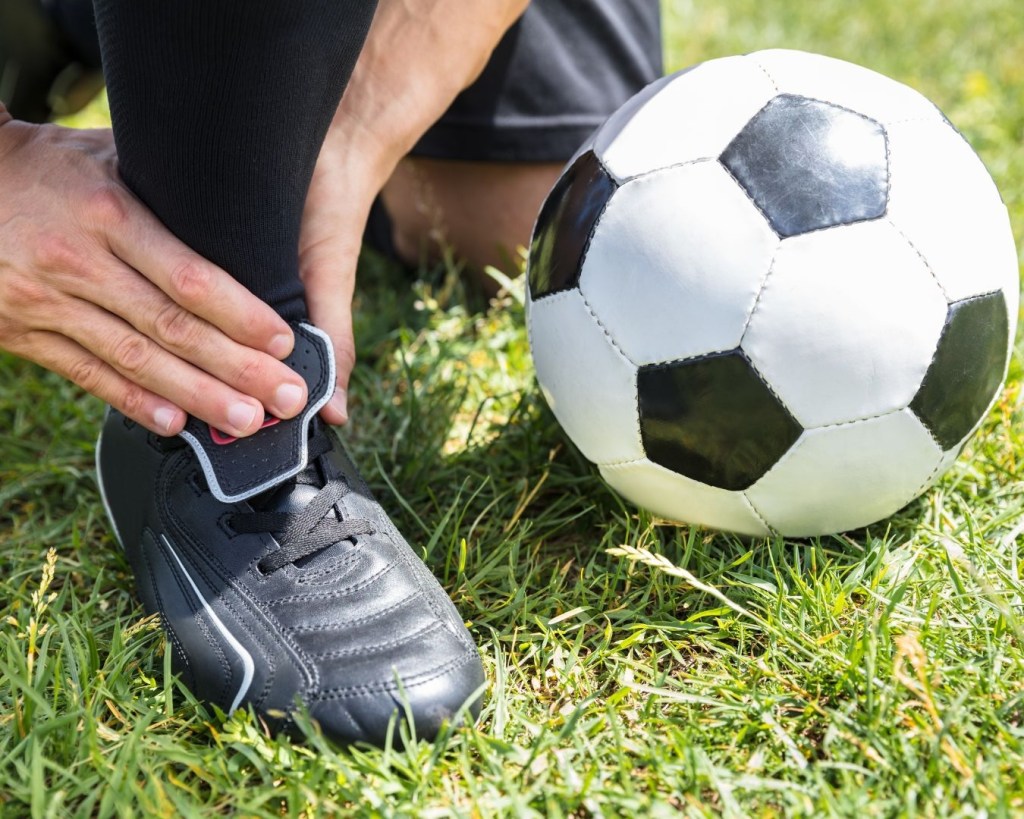
For young soccer players, an ankle injury can mean more than missing a few training sessions. Whether you’re sprinting down the wing, defending an opponent or diving to make a save, your ankles play an important role in almost every movement on the pitch.
One of the ligaments most commonly injured during an ankle sprain is the anterior talofibular ligament (ATFL). While many ankle sprains recover well, returning to soccer before the ankle has regained sufficient strength, stability and movement control can increase the risk of ongoing problems.
At Urban Health HQ, our exercise physiologists can support young athletes through a structured, individualised rehabilitation program designed to rebuild strength, improve movement and help them work towards a confident return to the sport they love.
What is an ATFL injury?
The anterior talofibular ligament, commonly known as the ATFL, is located on the outer side of the ankle. It is one of the ligaments that helps stabilise the ankle joint.
An ATFL injury commonly occurs when the ankle rolls or twists inwards, causing the ligament to stretch or tear. This is often referred to as a lateral ankle sprain.
For soccer players, this can happen when:
– Landing awkwardly after jumping for the ball
– Stepping on another player’s foot
– Changing direction quickly
– Losing balance while kicking
– Twisting the ankle during a tackle or challenge
– Running on uneven ground
ATFL injuries can vary in severity, from a mild ligament stretch to a partial or complete tear.
Common signs and symptoms
A young soccer player with an AFTL injury may experience:
– Pain on the outside of the ankle
– Swelling or bruising
– Tenderness around the ankle
– Reduced ankle movement
– Difficulty walking or putting weight through the foot
– Weakness or a feeling that the ankle may give way
The severity of symptoms can vary. If a young athlete experiences significant pain, swelling or difficulty bearing weight, an appropriate healthcare professional should assess the injury to determine the diagnosis and most suitable treatment.
Why is rehabilitation important for young soccer players?
It can be tempting to return to soccer as soon as the ankle starts to feel better. However, being able to walk comfortably does not necessarily mean the ankle is ready for sprinting, jumping, tackling or changing direction at speed.
Soccer places repeated demands on the ankle requiring players to move quickly and react to unpredictable situations.
After an ATFL injury, a player may experience reduced:
– Ankle and lower-limb strength
– Balance and proprioception
– Ankle range of motion
– Movement control
– Confidence when landing or changing directions
– Ability to tolerate running and repeated high-intensity efforts
These changes can affect how an athlete moves on the pitch and how well they tolerate the demands of training and competition.
Rehabilitation helps bridge the gap between everyday movement and the demands of returning to soccer.
How can exercise physiology support ATFL rehabilitation?
Exercise physiologists use structured exercise to support physical function, strength, movement and fitness.
For young soccer players recovering from an ATFL injury, rehabilitation should be individualised to the athlete rather than following a one-size-fits-all approach.
An exercise physiologist will consider the athlete’s injury, current abilities, sporting goals, training demands and stage of recovery when developing an appropriate program.
1.Individualised rehabilitation based on the athlete
Every athlete’s recovery is different.
A young player returning from an ankle sprain may have different needs depending on the severity of their injury, previous injury history, current symptoms and physical capacity.
Rehabilitation may focus on restoring physical qualities such as range of motion, strength, balance, coordination, movement control, and fitness, depending on the athlete’s needs.
Rather than prescribing the same program for every soccer player, exercise physiologists can adjust the focus, intensity and progression of rehabilitation to suit the individual.
2.Adapting rehabilitation to different soccer positions
Soccer is a team sport, but the physical demands can vary considerably between positions.
A goalkeeper, defender, midfielder and striker may all need to return to soccer following an ATFL injury, but their rehabilitation goals may differ.
Goalkeepers
Goalkeepers may need to consider the demands of diving, jumping, landing, rapid movements across the coals and reacting to unpredictable situations.
Rehabilitation can be progressed towards the movement demands relevant to their position, including the ability to move confidently and respond to different situations.
Defenders
Defenders may experience repeated demands involving short accelerations, changes of direction, jockeying, tackling and competing for the ball.
Their rehabilitation may be tailored towards the movement requirements of defending, including the ability to move and react effectively while maintaining control.
Midfielders
Midfielders often cover significant distances throughout a match and may repeatedly accelerate, decelerate, change direction and transition between attacking and defencive play.
Rehabilitation may need to consider their running capacity, repeated efforts, and ability to tolerate the demands of their position.
Strikers and attacking players
Strikers may need to sprint into spaces, change direction quickly, compete for the ball and perform movements associated with shooting and attacking play.
Their rehabilitation can be adapted to the demands of attacking movements and the physical requirements of their role.
These are examples of how rehabilitation mat be tailored to different sporting demands. The specific activities and progression will depend on the athlete’s injury, recovery and individual goals.
3. Progressing towards a return to soccer.
Returning to soccer involves more than simply being able to run again.
As the athlete progresses through rehabilitation, the focus may gradually shift towards the demands of training and competition.
This can include considering:
- General movement and physical capacity
- Running and repeated efforts
- Changes of direction
- Jumping and landing
- Position-specific movement demands
- Ball-related activities
- Training intensity and duration
- Confidence when performing soccer movements
The goal is to help the athlete build the capacity required for their sport in a gradual and appropriate way.
An athlete’s rehabilitation should not be rushed simply because they have an upcoming game or important competition. Returning to training and competition should be guided by their recovery, physical readiness and appropriate clinical advice.
Why a personalised approach matters
Two young soccer players can have the same type of ankle injury but require very different rehabilitation programs.
For example, a goalkeeper returning after an ATFL injury would likely have different sporting demands to a midfielder who needs to tolerate repeated running efforts throughout a match.
Similarly, a young athlete who has experienced multiple ankle sprains may have different rehabilitation considerations from someone recovering from their first ankle injury.
A personalised exercise physiology program allows rehabilitation to be adopted as the athlete progresses.
The aim is not simply to get the athlete moving again, but to help them build the physical capacity and confidence needed for their sport.
Supporting young soccer players at Urban Health HQ
At Urban Health HQ, we understand how important sports, such as soccer, can be to young people.
Being part of a team, developing skills and enjoying regular physical activity are all valuable parts of growing up. An injury can interrupt these experiences, making a structured and supportive rehabilitation process important for young athletes.
Our Exercise physiologists can support young soccer players through individualised exercise programs that focus on their physical needs and sporting goals.
Whether your child is returning to soccer after an ATFL injury, recovering from an ankle sprain or working to rebuild their physical capacity, rehabilitation can be tailored to their individual circumstances.
We recognise that every player is different. Their position, training demands, injury history, and goals can all influence the rehabilitation process.
Ready to support your young athlete’s recovery?
Contact Urban Health HQ today to discuss how exercise physiology can help your child work towards returning to the pitch.
Visit our website at https://urbanhealthhq.com.au or contact us by calling 0411563391 or email admin@urbanhealthhq.com.au

